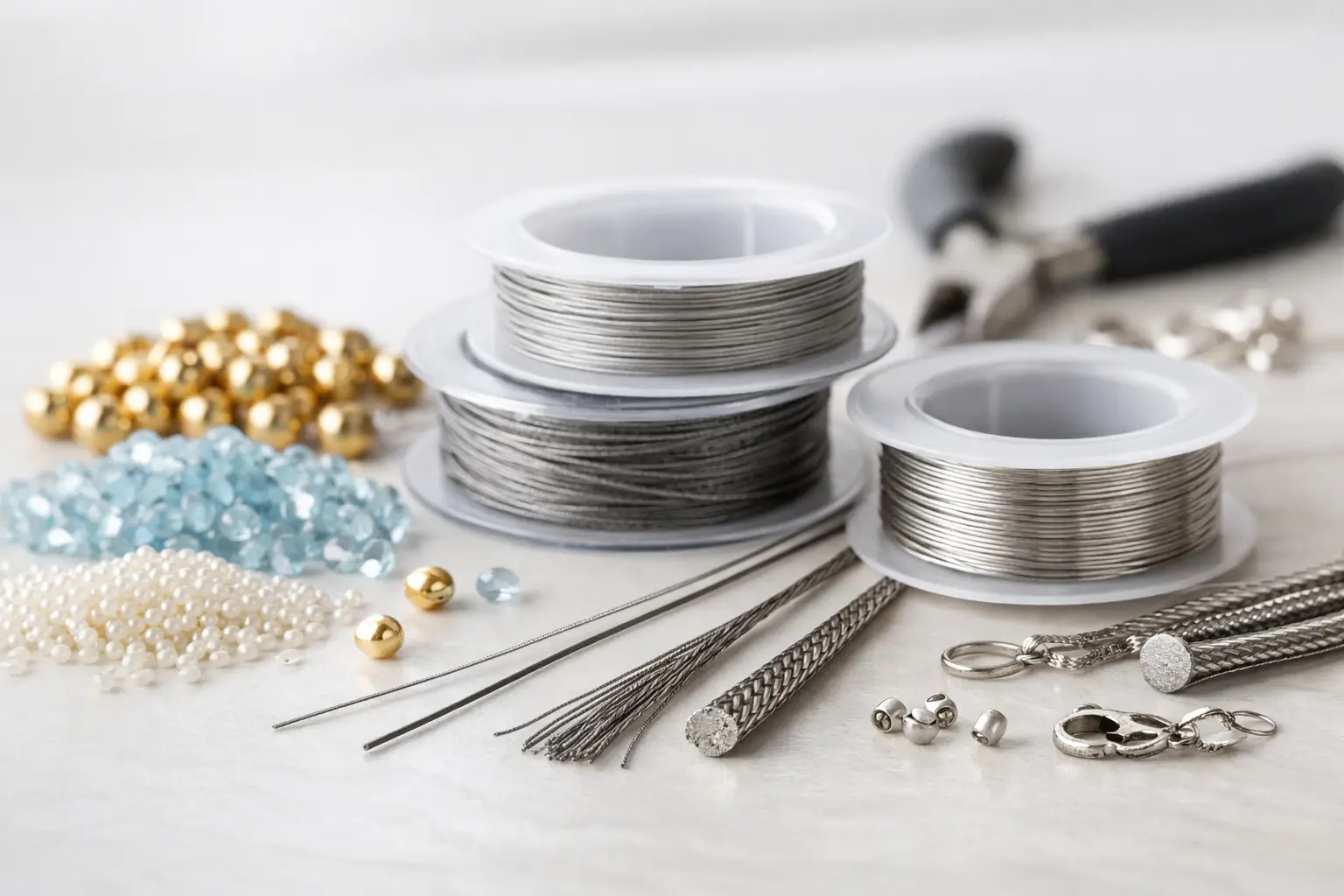
A necklace that kinks at the first curve or frays beside the clasp usually comes down to one choice made right at the start - the wire. This beading wire sizes and strand count guide is intended to make that choice simpler, especially when you are matching wire to specific beads, crimps and finished jewellery styles rather than guessing from the packet.
For most makers, the two details that matter first are diameter and strand count. Diameter affects whether the wire fits through the bead holes and how substantial the finished piece feels. Strand count affects flexibility, drape and how the wire behaves over time. Neither figure is better in every project. The right option depends on the bead size, bead weight, design movement and the finish you want.
What beading wire actually is
Beading wire is not the same as memory wire, nor is it the same as craft wire used for wrapped loops. It is a stranded steel cable with a protective nylon coating. That construction gives it strength for stringing while keeping it supple enough for necklaces, bracelets and some earrings.
You will usually see it sold by diameter, commonly in inches or millimetres, and by strand count, such as 7-strand, 19-strand or 49-strand. The coating slightly increases the overall thickness, so hole size matters. A wire that looks slim on the reel can still be too large once you account for bead tolerances, especially with smaller seed beads or tighter Czech glass holes.
Beading wire sizes and strand count guide for everyday projects
If you want a quick working rule, think of diameter as the fit and strand count as the feel. Diameter decides whether the wire passes comfortably through the beads and crimps. Strand count decides whether the finished piece is wiry or fluid.
Common wire diameters
0.30 mm to 0.38 mm is a useful fine range for lighter projects, smaller glass beads and designs where you need a little more room through the hole. It is often the safest place to start when you are combining smaller rounds, seed beads as spacers or compact clasps. The trade-off is that finer wire is less suited to very weighty beads or pieces that will take hard daily wear.
0.45 mm to 0.46 mm is one of the most versatile sizes for general necklace and bracelet work. It offers a good balance between strength and bead compatibility, which is why many makers treat it as a standard all-rounder. If you are working with 4 mm to 8 mm beads and conventional findings, this size often gives the fewest surprises.
0.50 mm to 0.53 mm suits heavier designs, larger bead holes and pieces where a firmer line is acceptable. Semi-precious rounds, lampwork focal sections and chunkier glass beads can all justify moving up. The compromise is reduced flexibility and less margin for narrow-hole components.
0.60 mm and above is usually reserved for substantial beads, stronger visual structure or specialist applications. It can be very effective in bold statement jewellery, but it is rarely the first choice if you need soft drape or if the design includes tighter-hole beads.
What strand count changes
7-strand wire is functional and economical. It is often perfectly adequate for straightforward stringing, simple bracelets and lower-cost makes. It does, however, feel stiffer and can kink more readily if bent sharply. For designs that need graceful movement, it may feel a little mechanical.
19-strand wire is the practical middle ground and a reliable choice for many makers. It offers noticeably better flexibility than 7-strand without pushing the cost as high as premium options. If you sell finished jewellery and need dependable results across a broad range of designs, this is often where value and performance meet.
49-strand wire is the softest and most cable-like of the common options. It drapes well, resists kinking better and tends to suit more refined finished pieces. It costs more, so it makes the most sense where feel, movement and finish quality matter enough to justify it.
Choosing wire by bead type
Bead size on paper is only half the story. Hole shape, edge finish and manufacturing tolerance all influence how well a wire performs.
With larger glass rounds, gemstone beads and many metal beads, a medium diameter such as 0.45 mm or 0.46 mm is often comfortable. You get enough strength without making the piece overly rigid. If the beads are weighty or the design includes a heavy pendant section, moving to 0.50 mm can be sensible.
With smaller crystals, petite pressed glass and mixed-stringing designs that use spacers with narrower holes, a finer wire can save frustration. If you are planning several passes through a component or using bead tips and tighter clasps, extra thickness adds up quickly.
Seed beads are where makers need to be more careful. Standard beading wire is generally not intended for beadweaving-style passes through Miyuki Delicas or small seed beads. Some larger seed beads may fit a fine wire for spacer use, but if the design relies on multiple passes, thread or braided line is usually the correct material. Trying to force a stringing wire into a beadwoven job often leads to cracked beads, distorted tension and wasted time.
Matching wire to the jewellery style
A floating necklace, soft draped bracelet or elegant multi-strand design benefits from higher strand counts because movement is visible in the finished piece. A stiffer wire makes these designs look less polished. For these styles, 19-strand or 49-strand is often worth choosing even if the beads themselves are not especially heavy.
A short bracelet with simple rounds and a sturdy clasp is more forgiving. Here, a 7-strand or 19-strand wire may both work, depending on budget and finish level. If the bracelet will be worn daily, flexibility still matters because repeated bending near the clasp puts stress on the cable.
For statement pieces with larger focal beads, diameter often matters more than maximum softness. The wire must support the load first. Even so, do not oversize automatically. If the bead holes are generous but the design includes smaller metal spacers or a decorative clasp bar, the thickest wire may create problems at the ends.
Crimps, clasps and the ends of the piece
Wire choice is never just about the body of the design. The ends need to work as a system. Crimp tubes must match the wire diameter closely enough to grip securely without crushing awkwardly. If the crimp is too large, it may not lock properly. If it is too small, the wire can be damaged during closing.
The clasp is part of the calculation as well. Fine wire on a heavy magnetic clasp can be an unbalanced combination. Equally, a thick wire may not sit neatly through compact findings or bead tips. Test the full path before stringing the entire project - bead, crimp, wire guardian if used, and clasp loop.
This is especially relevant for makers producing repeatable stock. A design that works once with one batch of beads can still become awkward if the next batch has slightly tighter holes. Keeping notes on wire size, strand count and crimp size saves time when you reorder materials.
When softer is not always better
Higher strand count wire is usually nicer to handle, but there are trade-offs. It is more expensive, and in simple everyday designs the improvement may not be dramatic enough to matter to every customer. If you are making entry-level pieces, children’s jewellery or test samples, a lower strand count can still be a sensible commercial choice.
Softer wire can also encourage overhandling during stringing because it feels more forgiving. Sharp tools, flattened crimps and repeated reworking can damage any cable. Good technique still matters more than buying the most premium option on the shelf.
A practical starting point
If you are unsure where to begin, a medium diameter in 19-strand wire is often the most useful baseline for general stringing. It suits a wide range of glass and gemstone beads, gives a cleaner drape than 7-strand, and avoids some of the fit issues that come with thicker cable. From there, adjust down for smaller-hole beads and lighter pieces, or up for heavier designs.
For beadweavers who occasionally add strung sections, keep the materials separate in your mind. Thread and braided beading lines are for repeated passes and tension-based construction. Beading wire is for cable-style stringing with crimps and findings. Using each where it performs best gives more reliable results and fewer remake jobs.
If you stock up on one reel for regular workshop use, make it something versatile rather than extreme. A dependable mid-range wire will cover more projects, reduce compatibility issues and make planning easier when you are ordering beads, crimps and clasps together. That is usually the most efficient route for hobby makers and small jewellery businesses alike.
The neatest finished pieces rarely come from the heaviest wire or the most expensive strand count. They come from matching the wire to the beads, the design and the way the piece will actually be worn.