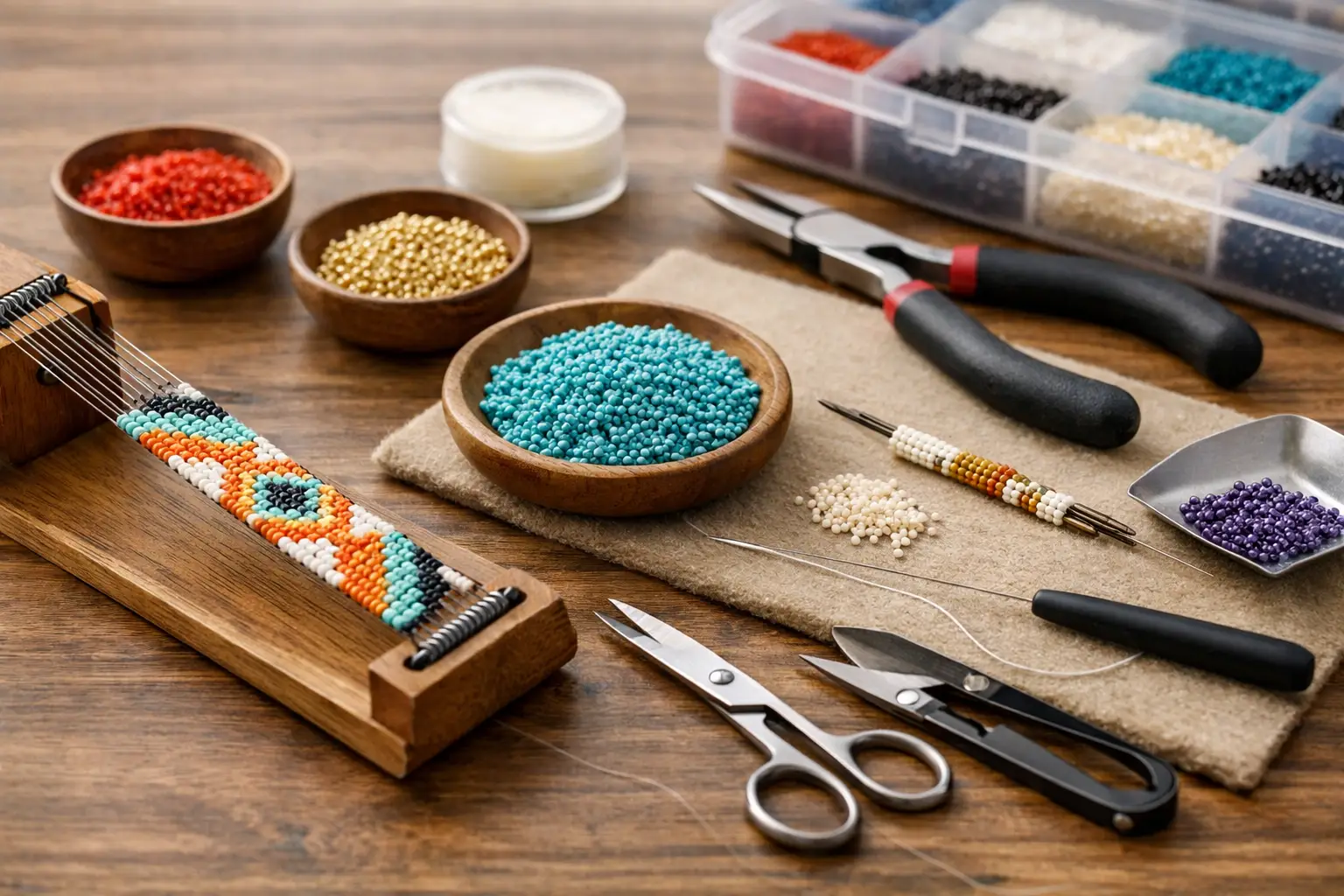
A beadweaving project usually tells you what is missing before you finish the first repeat. The thread frays more than expected, the needle flexes too much through a tight pass, or your scissors leave a fuzzy end that will not thread cleanly. That is why choosing the best tools for bead weaving matters - not as a shopping exercise, but because the right setup makes patterns more accurate, tension more consistent, and finishing far less frustrating.
For most makers, the aim is not to own every tool available. It is to build a reliable working kit that suits the beads, thread path and stitch structure you use most often. Peyote, brick stitch, right angle weave and multi-hole beadwork all place slightly different demands on your tools, so the best choice depends on what you make repeatedly, not just what looks useful on the bench.
What the best tools for bead weaving need to do
Good beadweaving tools solve specific problems. They help you pass through small holes multiple times, keep thread under control, trim neatly, open and close findings accurately, and protect the finish on components. If a tool cannot do one of those jobs cleanly, it is not really earning space in your kit.
The main trade-off is usually between delicacy and durability. A very fine needle is easier to pass through size 11/0s and Delicas on later thread paths, but it may bend or break more quickly. Heavier scissors last well, but very compact embroidery scissors are often easier to control close to beadwork. The best setup is usually a mix rather than a matched set.
Needles are still the first decision
If one tool affects bead weaving more than any other, it is the needle. For seed bead work, most makers will reach first for a proper beading needle rather than a general sewing needle. The profile is finer, the eye is narrower, and the needle can pass through beads repeatedly without opening up the thread path too much.
Size matters. A size 10 or 12 beading needle is often the sensible starting point for Miyuki Delicas, round seed beads and finer thread. If you work with denser thread paths or small embellishment beads, a size 12 gives you more room on later passes. If you are building structure with larger seed beads or working with slightly heavier thread, a size 10 may be easier to handle.
There is no perfect needle for every job. Short needles can feel more controlled for detailed weaving, while long needles are quicker when you are picking up repeated sequences. Big eye needles help some beginners, but they are not always ideal for tight beadwork because the eye section is bulkier. For repeatable, precise work, standard fine beading needles remain the dependable choice.
Thread is a tool as much as a material
In bead weaving, thread is part of the tool kit because it changes how every other tool performs. FireLine, WildFire, KO thread, Nymo and S-Lon all behave differently, and your needle, conditioner and finishing method need to suit the thread you are using.
For beadwork that needs structure and abrasion resistance, many makers prefer a braided thread such as FireLine. It cuts through less easily on bead edges and holds tension well in geometric work. The trade-off is that it can feel stiffer, and in softer drape-heavy pieces that firmness is not always ideal.
For a more supple finish, KO or Nymo can be the better choice. They are popular for off-loom stitches where flexibility matters, but they do ask a bit more from the maker. Thread can tangle more easily, and conditioning may help. If your work includes multiple passes through precision Japanese beads, thread diameter becomes especially important. A thread that is excellent for one bracelet design may be too bulky for another.
Thread conditioners and why they are worth having
A thread conditioner is not essential in every project, but it is one of those tools you miss when you need it and do not have it to hand. On softer threads, it can reduce tangling, limit fraying and help the thread travel more smoothly through the beads.
It depends on the thread. Braided beading threads generally need less help, while nylon threads often benefit more. If you mostly use KO or Nymo for intricate stitched work, a conditioner can make the whole process more controlled. If you work mainly with FireLine, it is less central, though still useful in some situations.
The key is moderation. Too much product can leave residue or affect the thread’s feel, so a light pass is usually enough.
Scissors need to cut cleanly, not just sharply
Poor thread trimming causes more problems than many makers expect. If the cut end is crushed or ragged, threading the needle becomes slower, and finishing knots or tail management is less tidy. Fine, sharp scissors are one of the best tools for bead weaving simply because they remove friction from every stage of the project.
Small embroidery scissors or dedicated thread snips are usually better than general household scissors. You need a fine tip for cutting close to the work without nicking surrounding threads. It is worth keeping these scissors for thread only. The moment they start being used on paper, packaging or wire, they stop performing where it matters.
If you work at different benches or carry projects out with you, having a second pair is often more practical than constantly moving one around. It is a small upgrade that saves time.
A bead mat is not optional for precision work
Bead mats do not get much attention, but they should. Delicas, seed beads and small accent beads move easily, and once they roll, they are either mixed, lost or chipped. A proper mat keeps beads where you put them and makes picking them up with the needle much easier.
For colour sorting and repeat patterns, a flocked board or segmented tray can also help, especially if you are working from a chart. The advantage is not just neatness. It reduces picking errors and helps you see your sequence at a glance.
If you switch between small seed bead weaving and projects using Czechmates or other multi-hole bead systems, it is worth having a couple of surfaces available. A flat bead mat is ideal for free pickup, while a tray with channels can be more useful when you need to separate components by step.
Fine chain nose pliers and flush cutters matter at finishing stage
Off-loom weaving may be thread-led, but the finish often depends on metal findings. Clasps, jump rings, wire guards and connectors all need accurate handling, and that means proper pliers.
Fine chain nose pliers give control without taking up too much room around small findings. Smooth jaws are preferable because they are less likely to mark plated components. If you regularly attach beadwoven pieces to clasps or earring fittings, two pairs of chain nose pliers are often more useful than one chain nose and one larger household pair. They let you open jump rings cleanly rather than pulling them out of shape.
Flush cutters are equally important if your work includes wire guardians, head pins, eye pins or light wirework as part of the design. A true flush cut is cleaner, safer and easier to turn into a neat finish. It also reduces snag points near thread.
A bead reamer and awl can rescue awkward projects
These are not everyday tools for every maker, but they are useful problem-solvers. A bead reamer can help clear slight obstructions in some bead holes, particularly when you are working with mixed materials or occasional irregular beads. An awl helps with knot placement, thread teasing and small adjustments during finishing.
That said, neither should be used as a substitute for suitable beads or correct thread choice. If you constantly need to force holes open, the issue may be the bead range, the finish build-up or the number of thread passes in the design. Use these tools sparingly and with care.
Lighting and magnification are tools too
For detailed bead weaving, lighting is not a luxury purchase. It affects speed, accuracy and fatigue. Good task lighting helps you distinguish finishes, read thread paths and spot mistakes before they spread through a repeat.
Magnification depends on the maker. Some beadweavers are happy with a daylight lamp alone, while others prefer a magnifying lamp for size 15 work, dark colours or evening sessions. There is no virtue in straining your eyes. If better lighting lets you weave for longer with fewer errors, it belongs in the tool kit.
Building your kit around the way you actually bead
The best tools for bead weaving are not necessarily the most expensive or the most numerous. They are the ones that match your usual materials and methods. If you mainly weave with Miyuki Delicas and fine thread, invest first in good needles, clean-cutting scissors, a stable bead mat and thread that suits repeated passes. If your work often combines woven sections with findings and connectors, fine pliers deserve equal priority.
For many makers, the most efficient route is to buy tools in the same practical way they buy beads - by compatibility, repeat use and project type. A dependable supplier with proper product detail makes that much easier, particularly when you need exact thread brands, bead sizes and findings that work together. CJ Beaders is well set up for that kind of project-led buying.
Start with the tools that remove the biggest irritation from your current work. The next bracelet, pendant or pair of earrings usually tells you what to upgrade next.