You finish the last row of Delicas, tension is spot on, thread path is tidy - then the clasp lets the whole piece down. It might feel too fiddly to fasten, it might spin the bracelet so the focal sits underneath, or it might be that one customer message you never want: “It fell off.”
Choosing between a toggle and a lobster clasp is rarely about which is “better”. It is about how the piece will be worn, how it is constructed, and what you need the closure to do. Below is a practical, maker-focused look at toggle clasp vs lobster clasp, with the trade-offs that matter when you are building in seed beads, multi-hole systems, or strung designs.
Toggle clasp vs lobster clasp: what actually changes?
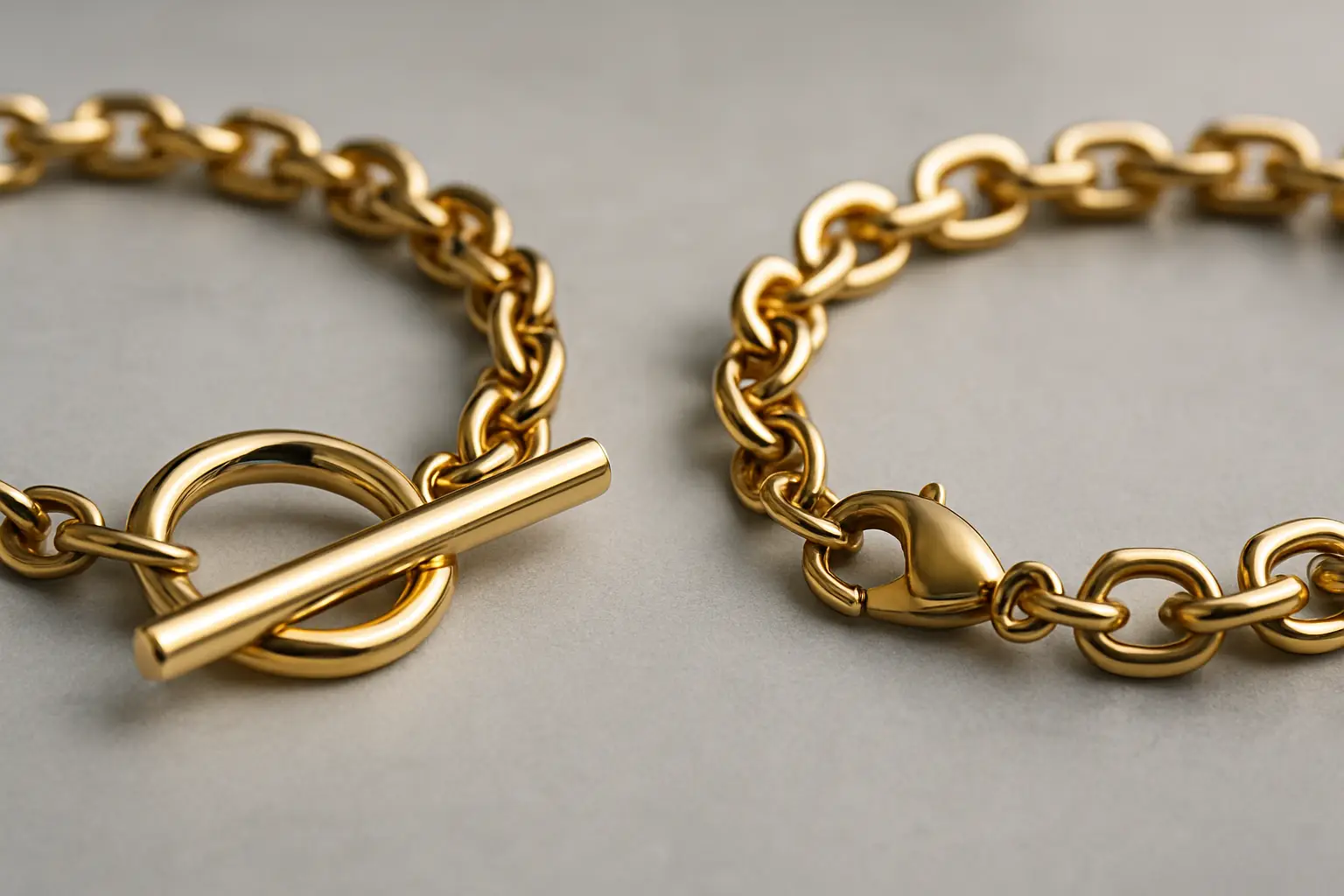
A toggle clasp is a bar and ring. You pass the bar through the ring and it sits crossways to hold. Most toggles are happiest when there is a little tension in the bracelet or necklace - the ring stays open, the bar sits neatly, and the closure becomes a design feature.
A lobster clasp is a spring-loaded mechanism with a lever. You open it, clip onto a jump ring or chain link, and the spring closes it. It is compact, usually less decorative, and behaves more predictably across different lengths because it does not rely on tension in the same way.
From a build perspective, the biggest differences are (1) how secure the clasp remains under slack movement, (2) how easy it is to fasten on your own, and (3) how much the clasp needs to be designed into the piece rather than simply attached.
Security: when each clasp is most reliable
If you sell your work or make gifts, security is the first filter. The “right” clasp is the one that stays closed under the sort of movement the piece will see.
A lobster clasp is generally the safer default. The spring closure resists accidental opening and it will still hold even if the bracelet is worn a touch loose. If the wearer catches the clasp on clothing, it is more likely to tug the bracelet around the wrist than to open the clasp.
A toggle clasp can be secure, but it depends on proportions and fit. If the ring is large relative to the bar, or the bracelet is loose, the bar can rotate and slip back through the ring. This is more likely with heavier focal beads, drapey beadwork, or longer lengths where the closure can migrate and sit at the side of the wrist.
There are ways to improve toggle security. Using a smaller ring, a longer bar, or a ring shape with a tighter opening helps. Position also matters: toggles behave best when they are pulled straight, not at an angle. That is why they tend to be more reliable on snug bracelets than on long necklaces.
Ease of fastening: be honest about the wearer
If a customer cannot fasten it easily, they will not wear it. This is where toggles often win.
A toggle clasp is usually easier one-handed, especially on bracelets. You can pinch the ring, push the bar through, and it “finds” its locked position without needing fine motor control. For people with limited dexterity, longer nails, or arthritis, toggles can be a practical choice.
A lobster clasp is smaller and requires you to hold the clasp, lift the lever, and connect to a ring - often behind the neck or with the bracelet already on the wrist. Some makers solve this with an extender chain and a larger end ring, but it is still more fiddly than a toggle for many wearers.
If you are making for yourself, test it in real conditions: standing up, no mirror, and using your non-dominant hand. If you are making to sell, consider whether your typical buyer prefers convenience (toggle) or maximum security (lobster).
Wear and tear: what fails first
Both clasp styles can last years, but the failure points differ.
With lobster clasps, the spring mechanism is the key component. Better-quality clasps hold their tension and close cleanly. Lower-quality versions can feel gritty, snag, or lose spring strength over time. A lobster clasp also needs a properly closed jump ring at the connection point - a slightly open ring is often the real reason a clasp “failed”.
With toggles, there is no spring to fatigue, but the ring can distort if the metal is soft or the piece is heavy. A toggle can also show wear where the bar rubs against the ring. That is mostly cosmetic, but if the ring stretches, the risk of slipping increases.
For beadwoven pieces, thread wear is also part of clasp durability. If your clasp attaches via a beaded loop, the loop needs to be sized and reinforced to avoid abrasion. If it attaches via a jump ring into a metal finding, check that there are no sharp edges at the join.
How the clasp affects the look (and the balance)
A toggle clasp is visible. In many designs it is meant to be seen, and you can use that to your advantage. On a simple Peyote rope or a minimalist strung necklace, a decorative toggle can become the “finishing” element that makes the piece look intentional.
The drawback is that toggles tend to rotate to the side of the wrist. If your focal needs to sit dead-centre, a toggle may encourage the bracelet to spin, particularly if the clasp is heavier than the beadwork.
A lobster clasp is usually treated as a utility part. It hides at the back of the neck or underneath the wrist and lets your beadwork stay the star. It also works neatly with extender chains, which is helpful when you want one design to fit multiple wrist sizes.
If your design includes multi-hole beads or a structured front section (for example, a Czechmates-based component), consider whether a decorative toggle competes with the focal. If you want the clasp to disappear, lobster is the straightforward route.
Best uses in seed beadwork and multi-hole systems
In bead weaving, you are often joining thread-based structures to metal findings. The clasp choice changes how you finish the ends.
Toggles pair well with beaded end loops because the ring can sit directly in a reinforced loop, and the bar can be attached to a matching loop at the other end. This is common on Peyote, Right Angle Weave, and loomwork bracelets where you have a flat end section to build into. Tension matters here: if the bracelet is intended to be worn loose, the toggle’s security drops.
Lobster clasps work well when you need adjustability. Add a short extender chain and the wearer can fine-tune fit, which is useful for selling online where you cannot size every wrist. Lobsters also suit pieces where the beadwork ends are narrow or tubular, as you can attach the clasp with a jump ring to a metal cone, cord end, or a small beaded loop without needing the clasp to “sit” a particular way.
For heavier beadwork - think dense Delica patterns, stacked Tilas, or multi-hole components with multiple strands - the clasp must match the weight. A small lobster can look lost and may not feel proportionate. A toggle can handle visual weight well, but test the hang so the closure does not become the heaviest point that drags to the side.
Sizing and component choices that prevent common problems
Most clasp complaints come back to sizing rather than the clasp style.
With toggles, match bar length to ring size. You want the bar to sit comfortably across the ring with enough overhang that it cannot line up and slip through under casual movement. If you are adding the toggle via jump rings, keep the ring count minimal so the clasp does not flop and present the bar back towards the opening.
With lobster clasps, choose a clasp size that suits the piece and the wearer. Very small lobsters can be neat, but they are harder to operate and can feel mismatched on chunky beadwork. Pair the lobster with a generously sized end ring or a short extender so the wearer has something easy to aim for.
Whichever you use, jump ring quality and closure matters. Close jump rings by twisting side-to-side, not pulling the ends apart, and check that the cut ends meet cleanly. If you are working with thread, reinforce loops with additional passes and keep them smooth so metal parts do not chew through your fibres.
When to choose which clasp (real-world scenarios)
If you make fitted bracelets, especially flat beadwork that is designed to sit snugly, toggles are often a good match. They are quick to fasten, look deliberate, and do not require an extender.
If you sell sizes in ranges or want one length to suit many people, a lobster clasp with an extender is usually the safer option. It reduces returns and “it doesn’t fit” messages, and it is less dependent on the bracelet sitting under tension.
If the wearer prioritises ease, toggle is worth considering. If the wearer prioritises “I never want to worry about losing it”, lobster is generally the better call.
For necklaces, lobsters tend to be more dependable, especially on longer lengths where a toggle can end up under less tension and more movement. Toggles can still work on short, fitted chokers or pieces where you intentionally want the clasp on show at the front or side.
If you are building a coordinated set, think about consistency. A toggle on the bracelet and a lobster on the necklace is not wrong, but customers often like the hardware to feel like it belongs together.
Stocking and making efficiently
If you make in batches, it helps to standardise your clasp strategy per product type. Keep a couple of reliable lobster sizes for everyday pieces, and a small range of toggles for designs where the clasp is part of the look. That approach makes your bill of materials predictable and your finishing process repeatable.
When you are ready to pick components, having clasps, jump rings, thread, and the bead families you use most in one place keeps projects moving. CJ Beaders stocks a broad spread of findings alongside Miyuki and Czech ranges, so you can build a complete materials list without splitting your order across multiple suppliers: https://Www.cjbeaders.com
The final check is simple: fasten the piece ten times, then tug it gently in the direction it will be pulled during wear. If it still feels right and sits where you designed it to sit, that is the clasp you should use - not the one that sounded best on paper.