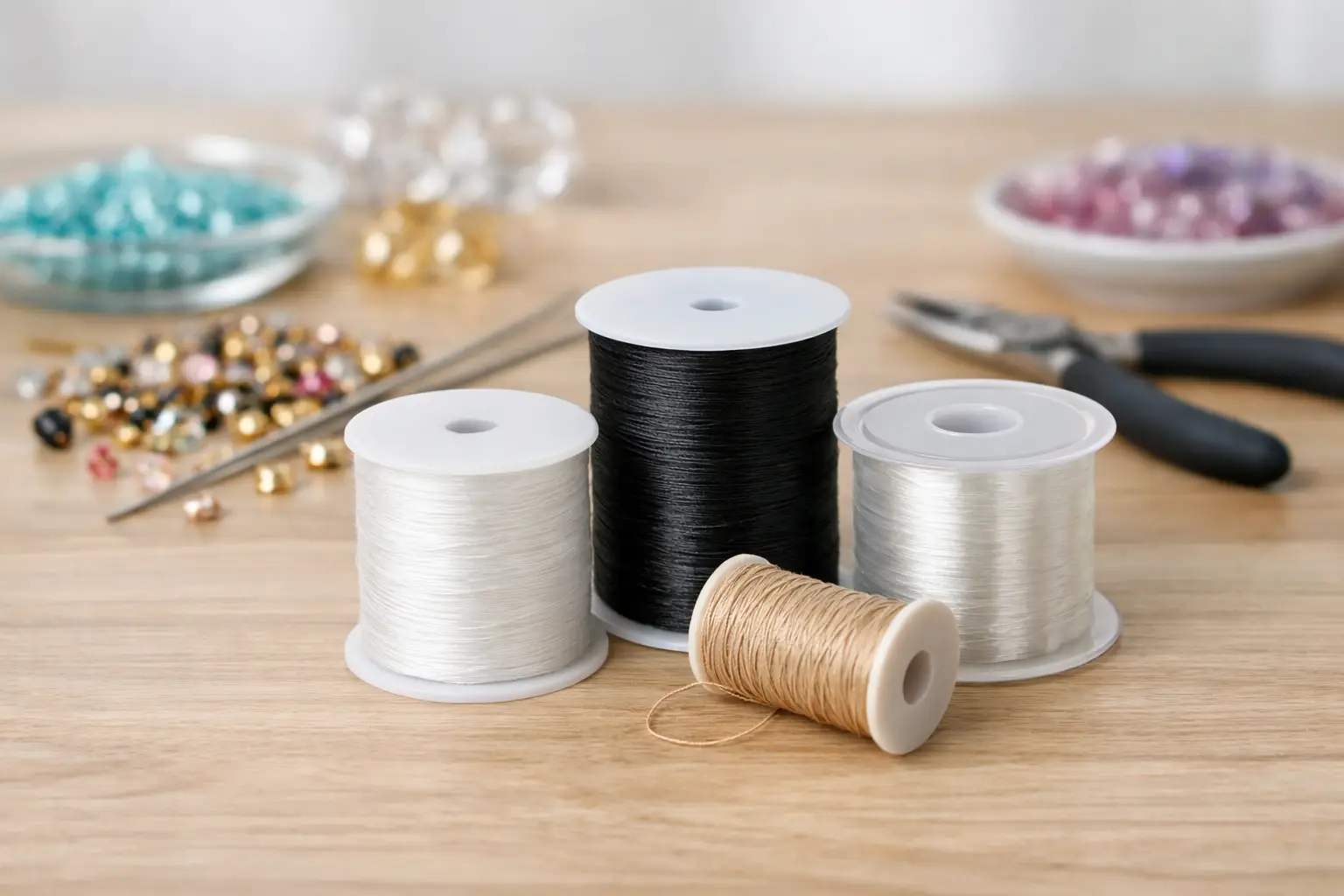
If a beadwork design starts to feel wrong before you've even finished the first repeat, the thread is often the reason. Tension is inconsistent, the needle drags, knots show, or the finished piece feels softer or stiffer than planned. With precision beads such as Miyuki Delicas and seed beads, small differences in thread choice become very obvious very quickly.
Beading thread is not one category in practice. It covers bonded lines for beadweaving, nylon threads for off-loom work, cord-like options for macramé and kumihimo, silk for knotting, and heavier materials for leather or mixed-media jewellery. The right choice depends on bead hole size, stitch structure, drape, abrasion, and whether the piece is decorative, wearable, or made for sale.
What beading thread actually needs to do
The basic job sounds simple - pass through the bead, hold tension, and last. In reality, those requirements often compete with each other. A finer thread passes through small holes and allows more thread passes, but it may feel too soft for firm geometric beadwork. A stronger thread sounds like the safe option, but if it is too thick or wiry, it can fight the stitch and reduce flexibility.
For beadweavers using Delicas, rounds, and shaped beads in the same project, abrasion matters just as much as strength. Multi-hole Czech beads, bugles, metal findings and crystal edges can all create wear points. If you are making pieces to sell, consistency matters too. A thread that behaves the same way from one spool to the next makes repeat production easier.
Beading thread for beadweaving
For peyote, brick stitch, herringbone, right angle weave and similar off-loom work, the most common decision is between braided or bonded beading lines and softer nylon threads.
Fireline and Wildfire
Fireline remains a standard choice for many beadweavers, particularly where structure matters. It is strong, relatively resistant to fraying, and gives beadwork a crisp feel that suits Delica work, bezels and shaped designs. It can also help when a pattern needs clean thread paths through precise cylinders. The trade-off is feel. Some makers find it slightly stiff, especially in the first few rows, and darker colours can leave visible marks on very pale beads if handled heavily.
Wildfire sits in a similar space. It is designed for beadworking, has good abrasion resistance, and many makers prefer the handling. Depending on the project, it can feel a little more controlled and less springy. Choice between Fireline and Wildfire often comes down to personal handling preference rather than one being universally better.
For either option, size matters. A finer diameter is useful when a pattern requires many thread passes through Delicas or small seed beads. A heavier size may be better for larger-holed beads, sculptural work or high-wear items such as bracelets.
KO thread and Nymo
KO thread is popular for bead embroidery and beadweaving where a softer finish is preferred. It is pre-conditioned, handles well straight from the spool, and is widely used for Japanese seed bead techniques. It lays neatly, knots well, and gives a more textile-like feel than bonded line. That can be ideal for fringe, softer drape, and intricate stitching where flexibility matters.
Nymo is another long-standing option. It is versatile and available in useful colours and sizes, but some makers still condition it depending on the technique. Properly matched to the project, it can produce excellent results. Compared with Fireline or Wildfire, however, it may need a little more thread management to avoid twisting or wear.
If your work includes delicate edging, fringe or embellishment on bead embroidery foundations, KO and Nymo are often easier to control. If you are building a firm cuff or a structured geometric form, bonded thread often gives a more stable result.
Matching thread to bead type
The bead itself usually narrows the choice faster than the stitch does.
Miyuki Delicas and small seed beads
Delicas reward precision. Because the holes are relatively generous for the bead size, they allow multiple passes, but dense patterns can still fill the hole quickly. Fine Fireline, Wildfire or KO thread are usually the most practical choices here. If the design includes lots of step-ups, joins and embellishment, thread bulk becomes a real factor.
With size 15 seed beads, thread thickness is even more critical. A thread that feels manageable in size 11s can become awkward very quickly. In these cases, many beadweavers move towards finer diameters and accept that they may need to balance strength against passability.
Czechmates and other multi-hole beads
Multi-hole systems place more emphasis on abrasion and path planning. Threads may sit at sharper angles within the bead structure, especially on edges and at joins. Fireline and Wildfire are common choices because they stand up well to friction and support more architectural designs. Softer nylon threads can still work, but they need closer attention where the thread path turns tightly.
Bugles, crystals and metal components
These are the areas where thread can fail early if the match is poor. Sharp-edged bugles and some crystal holes are harder on soft threads. Bonded beading thread is often the safer choice, though it is still sensible to inspect components and avoid forcing thread through rough holes.
When cord and silk make more sense
Not every project should use beadweaving thread.
S-Lon and similar cords are better suited to kumihimo, macramé, larger-hole beads and some bead crochet work. They offer body and visibility that would be completely wrong for peyote but ideal where the cord is part of the design.
Griffin silk belongs in a different category again. For knotting pearls, gemstones and classic stringing designs, silk provides drape and a traditional finish that braided bead thread cannot replicate. It is not the default answer for seed bead weaving, but for restrained, knotted jewellery it is still the right material.
Leather also has its place, especially for wrap bracelets, larger-holed beads and mixed-material jewellery. It is less about multiple thread passes and more about surface character, structure and compatibility with findings.
Colour, size and finish are not minor details
Thread colour affects the finished look more than many makers expect. With opaque Delicas, a close match is often enough. With transparent or lined beads, the thread can alter the apparent tone of the beadwork. Black thread behind transparent beads can deepen the colour. White or pale thread can brighten it. Neutral shades are useful, but not automatically invisible.
Size matters just as much. If you are forcing the needle through on later passes, the thread is probably too heavy for that bead and pattern combination. If the beadwork feels limp when it should hold shape, it may be too fine or too soft. The practical answer is not one universal spool, but a small working range matched to the projects you make most often.
A sensible way to choose beading thread
If you mainly work with Miyuki seed beads, Delicas and off-loom stitches, start by deciding whether the piece needs structure or drape. For structure, try Fireline or Wildfire in a diameter suitable for the bead size and number of passes. For softer movement, edging or fringe, KO thread is often the easier fit. If you already use Nymo successfully in your patterns, there is no reason to abandon it - just be realistic about wear points and conditioning.
If your projects combine seed beads with Czechmates, bugles, crystal or metal spacers, lean towards abrasion-resistant thread first and then check whether the diameter still allows the required passes. For knotted stringing, use silk. For corded techniques, use cord. Trying to make one thread do every job usually creates avoidable problems.
For anyone stocking up for repeat projects or customer orders, it makes sense to keep more than one type on hand. A fine bonded thread, a soft nylon bead thread, and a knotting or cord option will cover most jewellery-making work without overcomplicating the bench. That is also the most practical way to shop on a specialist site such as CJ Beaders, where beads, findings, needles and thread can be matched by project rather than bought in isolation.
The best beading thread is the one that suits the bead, the stitch and the finished use of the piece - and if a design starts fighting you, changing the thread is often faster than changing the pattern.