
Why use Lobster Clasps in your Jewellery making?
Lobster clasps are the unsung heroes of jewellery making –
tiny, secure and endlessly useful. If you make necklaces, bracelets, anklets or
bag charms, you’ll almost certainly reach for a lobster clasp at some point.
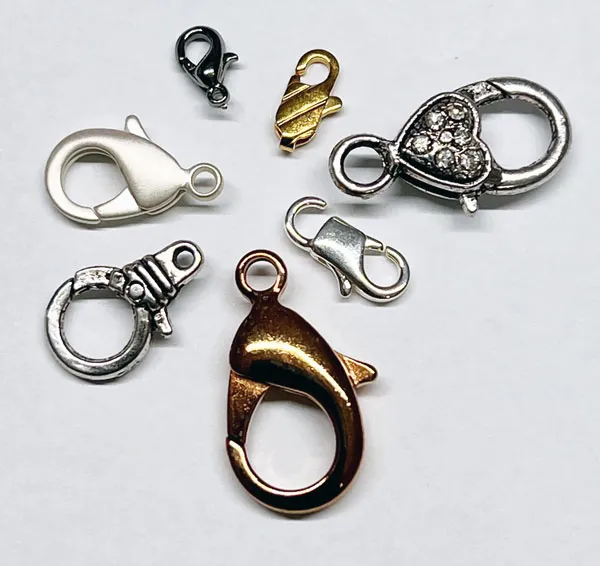
Below is a guide to lobster clasps, with practical tips for
choosing and using them, plus ideas for making the most of the wide range of
clasps available from CJ Beaders, who stock around fifty different Lobster
clasp options for jewellery makers.
What is a lobster clasp?
A lobster clasp (also called a lobster claw clasp,
trigger clasp or parrot clasp) is a spring-loaded jewellery
fastener commonly used on necklaces, bracelets and anklets. And larger sizes
will often be used on items such as handbags, phone clips, charms or Conference
name badges.
Key features:
- Body
– the main “claw” shape.
- Lever
/ trigger – the small moving arm you press with your thumb.
- Internal
spring – pulls the lever closed when you let go, keeping the clasp
securely shut.
- Attachment
loop – a small ring at the base, used to connect the clasp to jump
rings, chains, beading wire or cord.
The clasp opens when you press or pull the trigger, creating
a gap that can hook onto a jump ring, ring tag or extender chain. When you
release the trigger, the spring snaps it shut again, locking the jewellery in
place.
Why jewellery makers love lobster clasps
Lobster clasps are one of the most popular jewellery
clasp types for everyday wear. Here’s why they’re such a favourite:
- Very
secure – the spring mechanism makes them more robust than many small spring ring clasps and ideal for medium to heavy jewellery pieces.
- Versatile
– suitable for necklace clasps, bracelet clasps, anklets,
keyrings and bag charms.
- Available
in many sizes – from tiny 8–10 mm clasps for delicate chains to chunky
16–26 mm clasps for statement pieces.
- Metal
and finish options – available in many finishes – plated copper,
gunmetal, brass, silver and gold. Plus precious metal versions.
- Easy
to replace – you can swap a broken clasp on a favourite necklace using
basic jewellery-making tools to open up the attachment piece (normally a
jump ring).
- Great
for DIY jewellery repair kits – lobster clasps are a staple in most
beading supply boxes!
Because they balance security, durability and ease of use,
many jewellers consider lobster clasps the default clasp for everyday bracelets
and necklaces – and certainly are the most popular type of clasp amongst CJ
Beaders Customers.
Lobster clasp vs. other jewellery clasps
When you’re shopping for jewellery findings, you’ll
see lots of clasp types in fact CJ Beaders carry 14 different types. Here’s how
lobster clasps compare to some of the most common alternatives.
Lobster clasp vs spring ring (bolt ring)
- Spring ring / bolt ring clasps are round, hollow rings with a tiny internal
spring.
- They’re
neat and lightweight, so they’re popular on fine chain.
- However,
they can be fiddly and slightly less sturdy on heavier designs.
When to choose a lobster clasp
instead:
For medium-weight or heavier bracelets and necklaces, or for customers who
struggle with very small clasps, lobster clasps tend to feel more secure and
easier to grip.
Lobster clasp vs toggle clasp
- Toggle clasps feature a bar and a ring; the bar passes through the ring to
fasten the jewellery.
- They
add a decorative design element and are popular on chunky necklaces and
bracelets.
Choose a toggle clasp when:
- You
want the clasp to be part of the design they come in many different styles
- You’re
making a statement piece with weight to hold the toggle in place.
Choose a lobster clasp when:
- You
prioritise security over style, especially on high-value pieces or lighter
chains that might slip out of a toggle.
Lobster clasp vs magnetic clasp
- Magnetic clasps use two magnets that snap together easily – brilliant for
anyone with dexterity issues.
- They’re
very convenient, but not always the most secure option, especially for
heavy jewellery or if the piece might catch on clothing.
Lobster clasp advantage:
The mechanical spring-loaded closure is less likely to pull apart accidentally,
making lobster clasps more suitable for precious gemstones, sentimental pieces
and everyday bracelets that take a lot of wear.
Lobster clasp vs box, barrel & hook-and-eye clasps
Other popular necklace fasteners include:
- Box
clasps – elegant closures often used in fine jewellery and pearl
necklaces.
- Barrel
/ screw clasps – cylindrical closures that twist together.
- Hook-and-eye
clasps – a simple hook that catches onto a ring or loop.
These all have their place in jewellery design, but if you
only keep one style of clasp in your beading stash, a mixed pack of lobster
claw clasps in various sizes and finishes will cover most everyday
projects.
Choosing the right lobster clasp for your project
When you browse clasp ranges from suppliers like CJ
Beaders, you’ll see many variations. Here’s how to pick the best lobster
clasp for each jewellery design.
1. Size: matching clasp size to jewellery weight
As a rough guide:
- 8–10
mm lobster clasp – best for very delicate chain necklaces, fine
bracelets and lightweight anklets.
- 10–12
mm lobster clasp – a good all-round size for most everyday necklaces
and bracelets.
- 14–16
mm lobster clasp – suits chunky chains, charm bracelets and heavier
gemstone designs.
- 20
mm+ large lobster clasp – works as a focal clasp, on bag charms,
keyrings and lanyards.
If you’re unsure, go slightly larger for bracelets (they’re
easier for customers to fasten one-handed) and medium-sized for necklaces.
2. Metal & finish
Think about both aesthetics and practicality:
- Sterling
silver lobster clasp – perfect for fine silver jewellery and
higher-end designs.
- Gold-plated
or rose gold-plated lobster clasp – ideal when matching gold-tone or
rose-gold-tone chains.
- Stainless
steel lobster clasp – highly durable and more resistant to tarnish and
corrosion; great for everyday wear and men’s jewellery.
- Antique
bronze, copper, gunmetal finishes – excellent choices for vintage,
steampunk or rustic designs.
For customers with sensitive skin, all of those supplied by
CJ Beaders are EU Nickel compliant, unlike many clasps sold in non-EU countries.
3. Style & function
Within lobster clasps, you’ll also find:
- Standard
trigger clasps – simple, classic shape that suits almost any design.
- Swivel
lobster clasps – with a rotating loop, perfect for keyrings, bag
charms and ID lanyards because they reduce twisting.
- Decorative
lobster clasps – heart-shaped, textured or oversized clasps that
become part of the design. For instance, larger lobster clasps can be used
as a feature – front mounted on a longer chain or necklace such that it
appears like a pendant as in the illustration.
An extensive clasp range like the one on CJBeaders.com
(with around 50 different clasps in different sizes, styles and finishes) makes
it easy to coordinate your closures with your overall jewellery design.
How to attach a lobster clasp (step-by-step)
You don’t need to be an advanced jewellery maker to use
lobster clasps. Here’s how to attach them securely to different materials.
Tools you’ll need
- Chain-nose
pliers
- Round-nose
pliers (optional but helpful)
- Wire
cutters or thread snips
- Jump rings
- Crimp
beads or crimp tubes and wire Guardians (for beading wire)
A. Attaching a lobster clasp to beading wire
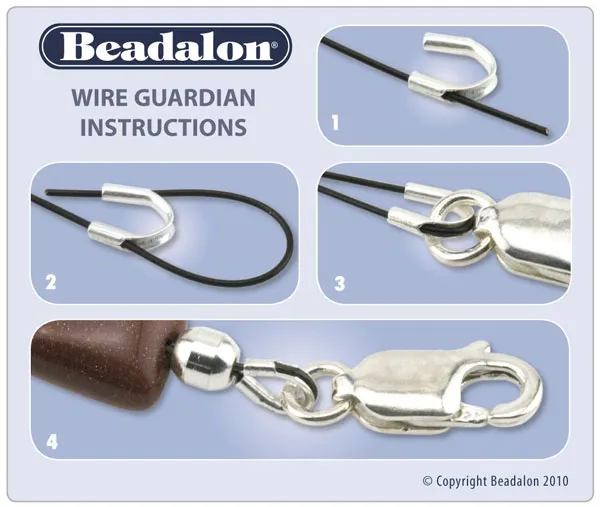
1. Thread
a crimp and jump ring
Slide the wire through a crimp
bead and through a wire guardian. Open a jump ring into the inner side of the wire
guardian.
2. Loop
back through the crimp
Take the wire tail back through
the crimp to form a small loop around the jump ring.
3. Crimp Use crimping pliers (or flat-nose pliers)
to squash the crimp securely.
4.
Trim excess wire Snip any short wire tail
and, if possible, tuck it back through the last few beads.
5. Add
the lobster clasp
o Open
the jump ring with two pairs of pliers (twist, don’t pull apart – think of it
like opening a door).
o Slide
on the lobster clasp and close the jump ring fully.
6.
Repeat on the other end Finish the second
side with a jump ring or extender chain so the lobster clasp has something to
hook onto.
NOTE: A quick word on Jump Rings. Other than make it
easy to change a Lobster clasp at a later time, a Jump Ring also acts as a
safety feature. Beading wire can be very strong and if a jump ring is not used
and your wire is attached directly to the clasp and your jewellery is snagged
hard, the wire can be forced into the skin and cause injury. A Jump ring will –
under high force – be pulled open and likely reduce injury.
B. Attaching a lobster clasp to chain
For chain necklaces, anklets and bracelets:
- Cut
the chain to length.
- Attach
a jump ring to one end of the chain and connect the lobster clasp.
- Close
the jump ring thoroughly so there’s no gap.
- On
the other end, add:
- A
single jump ring (for a fixed length), or
- A
short length of extender chain for adjustable sizing.
C. Attaching a lobster clasp to cord or leather
For leather or cotton cord:
- Glue
or crimp on cord ends (fold-over ends or end caps).
- Attach
jump rings to the cord ends.
- Add
the lobster clasp to one end and a jump ring or extender chain to the
other.
This allows you to mix lobster clasps with suede,
leather or waxed cotton cords while keeping everything neat and secure.
Caring for lobster clasps & troubleshooting
Even the best trigger clasps can wear out over time,
especially if exposed to moisture, perfume, hairspray or chemicals.
Basic care tips
- Wipe
jewellery (including the clasp) with a soft cloth after wearing.
- Keep
pieces dry and store them in a closed jewellery box or anti-tarnish bag.
- Avoid
spraying perfume or hairspray directly onto jewellery.
The internal spring can rust or become misaligned if exposed
to harsh conditions, which may cause the clasp to stop closing properly.
Common lobster clasp problems
- Clasp
doesn’t spring closed – the internal spring may be broken; it’s
usually easier to replace the clasp than repair it.
- Gap
in the lever when closed – gently squeeze the clasp body or replace
it; a visible gap can cause jewellery to fall off.
- Jump
ring keeps opening or Wire pulls through the gap? – switch to a
stronger jump ring, or use an Oval Jump Ring which tends to force the attachments
away from the gap.
Because lobster clasps are inexpensive and quick to change,
many jewellers routinely replace them during jewellery repairs and
re-stringing.
FAQ: lobster clasp questions jewellery makers ask
Are lobster clasps good for bracelets?
Yes. Lobster clasps are widely considered one of the most
secure bracelet clasps, especially for bracelets worn every day.
What size lobster clasp should I use?
- Fine
chain and dainty bracelets: 8–10 mm
- Everyday
necklaces and charm bracelets: 10–12 mm
- Heavy
gemstone jewellery or chunky chain: 14–16 mm+
For bracelets, err on the larger side; they’re easier to
fasten with one hand.
Are lobster clasps adjustable?
The clasp itself isn’t adjustable, but you can make
jewellery adjustable by adding an extender chain for the lobster clasp
to hook onto.
How many lobster clasps should I keep in my stash?
If you make jewellery regularly, it’s worth keeping:
- A
multipack of small silver-tone lobster clasps (8–10 mm)
- A
multipack of medium sizes (10–12 mm) in silver and gold tone
- A
few larger clasps (14 mm+) for chunky designs and bag charms
Supplier ranges like CJ Beaders’ extensive clasp
collection – with dozens of trigger, lobster, magnetic and other clasps –
make it easy to stock up on mixed sizes and finishes in one go.
Final thoughts
Whether you’re just starting out in jewellery making
or you’re an experienced designer, lobster clasps deserve a permanent
place in your findings box. They’re secure, versatile and available in almost
every metal, size and style you could need.
By understanding how lobster clasps work, how they compare
to other jewellery clasps, and how to attach them properly using jump
rings, crimps and chain, you’ll be able to finish your bracelets, necklaces and
anklets with confidence – and give your customers the reliable closures they
expect.
If you’re ready to stock up, explore the wide variety of
around 50 different clasps available from CJBeaders.com, and
match each jewellery project with the perfect clasp for both style and
security.